

It’s 9pm.
Kids are finally down. You’re not sad about anything specific.
You’re just flat.
No motivation. No joy in things that used to matter. A low-level grey that’s been there so long you’ve started to think it’s just who you are now.
It might not be.
Your brain needs specific nutrients to produce the chemicals that regulate your mood.
And most parents — running on skipped meals, poor sleep, and a Tuesday that starts at 5:30am — are deficient in at least two of them

Here’s what most people are never told about depression.
Your brain doesn’t produce mood chemicals from nothing.
Serotonin — the chemical most antidepressants target — requires specific nutritional building blocks to be synthesised.
Dopamine — your motivation and reward signal — requires others.
GABA — your brain’s natural calming signal — requires others still.
If those building blocks are missing, your brain cannot produce adequate amounts of these chemicals regardless of your mindset, regardless of your lifestyle, regardless of how hard you try to “think positive.”
The chemistry isn’t there.
And the five deficiencies most commonly linked to depression are also the five most commonly missed on standard blood panels.
───────────────────────────
What You’ll Learn in This Post:
→ 5 nutrient deficiencies directly linked to depression, anxiety, and low mood
→ Why parents are disproportionately affected by each one
→ The specific food sources and supplement forms (paid section)
→ Which combination addresses the most symptoms fastest (paid section)
→ Read time: 4 min
You don’t need all five. Identify the one or two that match your specific pattern. That’s where to start
5 Nutrient Deficiencies That Silently Drive Low Mood
Reordered by how commonly they appear in parents specifically.
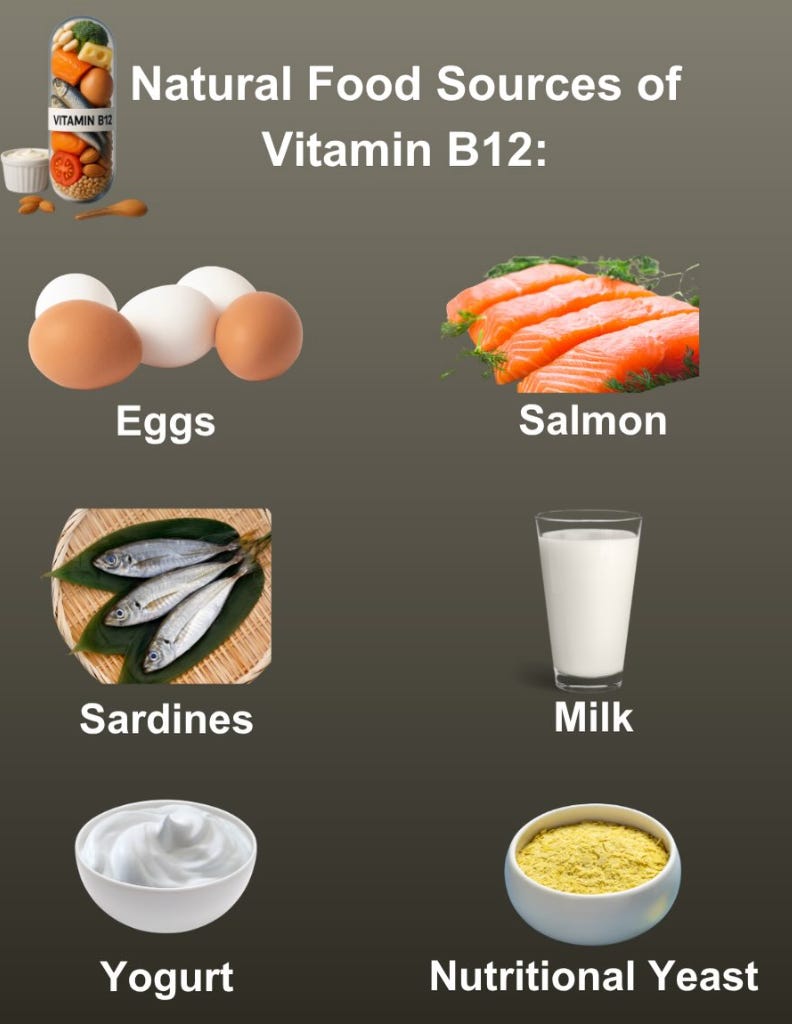
→ 1. Vitamin B12 — the one most parents over 35 are quietly losing
Your gut’s ability to absorb B12 declines with age, stress, and certain medications. Most parents have no idea it’s happening.
Vitamin B12 is the direct precursor to serotonin production. Without adequate B12, your brain cannot synthesise sufficient serotonin — the neurotransmitter most antidepressants are designed to preserve. B12 deficiency presents as fatigue, emotional flatness, low motivation, and cognitive fog before any blood test flags it as deficient. The most common causes in parents: low stomach acid from chronic stress — which directly impairs B12 absorption — combined with insufficient dietary intake during the chaotic years of active parenting. If you’ve been on antacids or have high stress levels, your B12 absorption has almost certainly been compromised.
FOOD→BRAIN LINK: Low B12 → insufficient serotonin synthesis → emotional flatness, fatigue, low motivation → brain fog by Tuesday afternoon → mood crashes that feel like depression but respond to nutrition.
The 3pm energy collapse that’s been going on for months. The flat feeling at 9pm when the kids are asleep and you expected to feel relief but just feel nothing. That’s the B12 picture.
→ 2. Vitamin D3 — the one nobody checks until it’s already affecting everything
Deficiency is found in the majority of people with depression. Most parents in northern climates are deficient for 6 months of every year.
Vitamin D3 is not just a bone mineral. It functions as a neurosteroid — directly supporting the production of both serotonin and dopamine. Vitamin D receptors are found throughout the brain, including in the regions responsible for mood regulation and emotional processing. Deficiency is consistently found in higher rates among people with depression than in the general population. Critically: genetic variations in how D3 is absorbed and activated mean that even people with “adequate” sun exposure may have functionally low D3 in the brain. Stress accelerates D3 depletion. Parents running on disrupted sleep and chronic low-grade stress are depleting their D3 stores faster than they can replenish them.
FOOD→BRAIN LINK: Low D3 → reduced serotonin and dopamine synthesis → mood instability, low motivation, increased anxiety → worsened sleep → more cortisol → further D3 depletion.
The mood that’s consistently worse in autumn and winter. The motivation that drops when the daylight does. The flatness that lifts noticeably on a sunny day — even before anything else changes. That’s D3 signalling.
→ 3. Folate — the one that 40% of people can’t properly absorb regardless of diet
Up to 40% of the population carries a genetic variation that reduces their ability to convert folate into the active form the brain actually uses.
Folate — specifically in its active form, methylfolate — is essential for the methylation process that produces serotonin, dopamine, and norepinephrine. Without adequate methylfolate, neurotransmitter synthesis slows across all three of these mood-regulating chemicals simultaneously. The MTHFR genetic variation — present in up to 40% of people — reduces the efficiency of this conversion by up to 70%. This means that eating folate-rich foods or taking standard folic acid supplements may provide little benefit. The brain needs the pre-converted form: methylfolate. Standard blood panels test for folate — not whether your body is successfully converting it.
FOOD→BRAIN LINK: Low methylfolate → impaired neurotransmitter synthesis across serotonin, dopamine, and norepinephrine → depression, anxiety, and brain fog that don’t respond to standard dietary improvements.
The parent who eats well, takes a multivitamin, does everything “right” — and still feels flat. If that’s you, MTHFR is worth investigating. The solution is simple. Getting to it requires knowing it exists

→ Before deficiencies 4 and 5
Everything above explains why the low mood keeps coming back despite doing everything the standard advice suggests.
But here’s what strikes me every time I work through this with someone.
The deficiency picture is always individual.
Your B12 absorption is different from your partner’s. Your D3 conversion is affected by your specific genetics. Your cortisol load from the school run and the back-to-back meetings is depleting nutrients at a rate that a generic supplement protocol can’t keep up with.
The most accurate picture of what’s driving your mood, energy, and cortisol — is already in your blood.
We build your plan from your blood test — not a template.
BloodPrint. 12 founding spots. Cohort 3 closes June 30. Application only. We don’t accept everyone.
→ Apply: https://tally.so/r/eqLZKe
Deficiencies 4 and 5 are the ones most people never consider.
Especially deficiency 4 — because it’s the one directly driven by the food pattern most parents reach for when stress hits hardest.
And after both: the exact form, dose, timing, and food source for each deficiency — including the one combination that addresses the most symptoms in the shortest time for a parent’s real schedule.
🔒 Paid members already have the full nutrient-mood protocol for this week.
Don’t miss the next one.
