

You did the noon cutoff.
Three weeks, no coffee after twelve, headaches on days four and five that you pushed through because the thread said your sleep depth would change within three nights.
It didn’t. And you assumed the problem was you.
What you’ll learn in this post:
→ Why a single clock time can’t work for a group of people whose bodies differ by six hours
→ Which two tips have real trials — and what those trials actually measured
→ The sentence in that thread that would get a doctor in trouble
→ Read time: 8 min
If you take one thing from today, take the cutoff calculation. It’s the only number here that’s yours instead of everyone’s.

THE ONE GOOD TIP HAS THE WRONG NUMBER ON IT
The caffeine tip is the strongest item on that list. It’s the only one that touches something physical you put in your body. And the number attached to it is arbitrary.
The thread says caffeine’s half-life is 5 to 7 hours, so cut at noon.
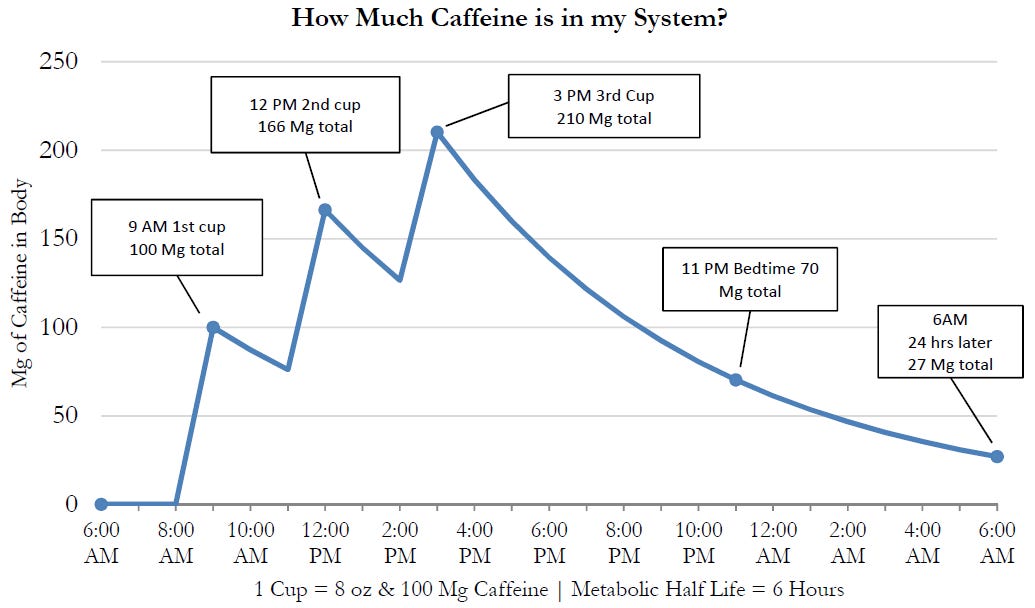
The actual range in healthy adults: the mean is around 5 hours, but individual elimination half-life spans roughly 1.5 to 9.5 hours (Institute of Medicine, Caffeine for the Sustainment of Mental Task Performance — https://www.ncbi.nlm.nih.gov/books/NBK223808/). Genetics, the oral contraceptive pill, pregnancy, smoking, and certain medications all move it. Fast metabolisers and slow metabolisers are not the same species of coffee drinker.
One clock time cannot serve a group whose bodies differ by six hours.
And noon is anchored to the wrong end of the day. Your caffeine doesn’t care what time lunch is. It cares when you’re trying to sleep. A noon cutoff with an 11pm bedtime is over-cautious. A noon cutoff for a slow metaboliser who’s in bed by 9:30 with a toddler is still too late.
I did the noon cutoff too. Week two, on a Wednesday around four, I snapped at my daughter over a cereal bowl she’d left on the table since breakfast. I had a headache I’d decided was detoxing. She didn’t say anything back. She just took the bowl to the sink.
Then there’s this line: “You’re not a bad sleeper. You’re caffeinated past your reset window.”
No. Some of you are not sleeping because of untreated sleep apnoea, or thyroid disease, or depression, or perimenopause, or a genuine insomnia disorder that has a first-line treatment with trials behind it. Pinning all of it on the 3pm coffee is the kind of single-cause confidence that keeps people out of a GP’s office for another eighteen months.
If your sleep has been broken most nights for months, the cutoff is worth doing and it is not a substitute for having it looked at.
THE TWO WITH REAL EVIDENCE
→ The caffeine cutoff. Keep it. Bin the noon.
Drake gave healthy sleepers 400mg of caffeine — two to three coffees — at bedtime, three hours before bed, and six hours before bed. All three disrupted sleep. Even six hours out, objectively measured sleep time dropped by more than an hour, and the participants reported they’d slept fine (Drake, 2013 — https://pmc.ncbi.nlm.nih.gov/articles/PMC3805807/).
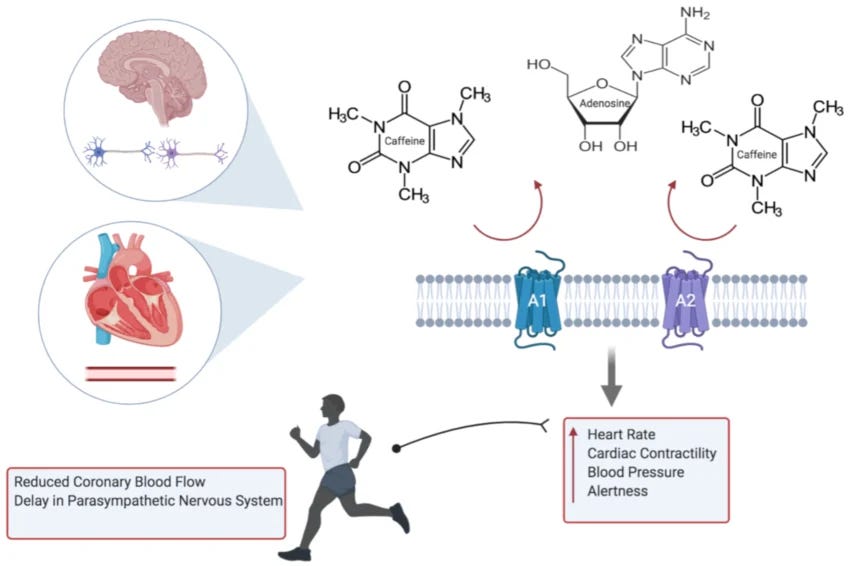
Caffeine → blocks adenosine, the molecule that builds up all day and creates sleep pressure → your brain stops registering how tired it actually is, hours after you stopped tasting it.
Twelve people. Small. And note what it means: six hours was the longest gap they tested and it still failed. Which is why the cutoff should be counted backwards from your bedtime — not forwards from your lunch. The calculation is below.
→ The unscheduled time. Keep it — and take it outside.
The tip says block 30 to 60 minutes with no phone, no task. It’s the best behavioural item on the list, and there’s a study that sharpens it enormously.
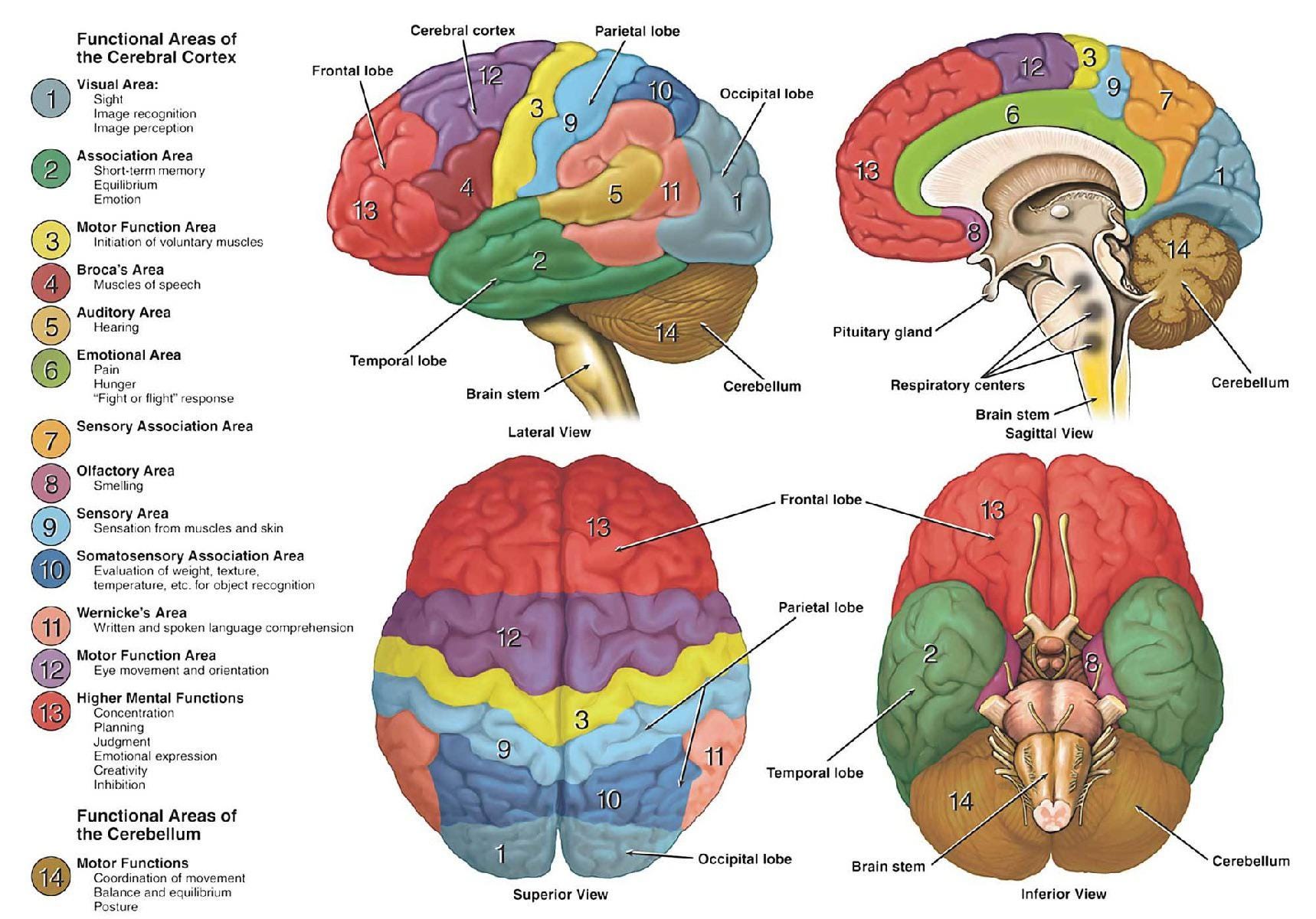
Stanford researchers sent people on a 90-minute walk in either a natural setting or a busy urban one. The nature group came back with lower rumination and reduced activity in the subgenual prefrontal cortex — the brain region tied to repetitive negative thinking. The urban walkers got no such change (Bratman, 2015 — https://www.pnas.org/doi/10.1073/pnas.1510459112).
Empty time in a grey room is fine. Empty time somewhere green is the version that moved a measured brain region.
That leaves six tips. One of them overlaps with a real sleep-lab finding and nobody mentions it. Three have no trial at all for what they promise. And the thread’s closing claim — that all eight point to one root, a nervous system baseline set too high — is the part with the least evidence in the entire post, presented as the most certain thing in it.
Here’s all eight graded, and the two-line calculation that gives you your actual cutoff.
The full sleep + nutrition protocol is inside — including the exact meal timing that works around your kids’ bedtime.
One question, and it splits everyone here into two completely different problems:
Do you struggle to fall asleep, or do you fall asleep fine and wake at 3?
Those are not the same thing and they don’t share a fix. The cutoff matters far more for one of them than the other, and almost every thread online treats them as one problem.
Reply with one word: falling or waking.
I’ll tell you which half of this post is actually yours, and which half to ignore.
YOUR ACTUAL CUTOFF — TWO LINES
Step 1. Write down the time you want to be asleep. Not in bed. Asleep.
Step 2. Subtract 8 hours. That’s your last caffeine.
Asleep by 10:30 → last coffee 2:30pm.
Asleep by 11:30 → last coffee 3:30pm.
Asleep by 9:30 (you have a baby) → last coffee 1:30pm.
Why eight and not six: six hours is where the evidence ran out, not where the problem stopped. Drake’s team measured over an hour of lost sleep at six hours and never tested further. So eight is a margin, not a finding, and I’ll say that out loud rather than dress it as a discovery.
If you’re a slow metaboliser, add two hours. You likely are if: you’re pregnant, on the combined pill, on certain antidepressants or antibiotics, or one coffee genuinely rattles you while other people drink four. Ask your pharmacist if you’re on anything — some common medications slow caffeine clearance dramatically.
The doses nobody counts: a large takeaway coffee can carry more caffeine than two home cups. Strong tea is roughly half a coffee. Green tea, cola, dark chocolate, and most “decaf” all carry some. Pre-workout is enormous. If your cutoff isn’t working, count the hidden ones before you move the clock again.
Halve before you move. If your new cutoff isn’t survivable this week, cut the afternoon dose in half rather than deleting it. Half a cup at 2:30 beats a full cup at 4:30.
THE OTHER SIX, GRADED
1. Hum for 60 seconds.
The long exhale inside humming shares a mechanism with something real: five minutes a day of exhale-focused breathing beat mindfulness meditation on mood in 108 randomised people (Balban, 2023 — https://www.sciencedirect.com/science/article/pii/S2666379122004748). But in that same trial, heart-rate variability didn’t change — the standard readout for the parasympathetic shift the humming tip promises. And nobody has tested humming specifically for cortisol. It’s a pleasant thing that may work through the exhale. That’s the honest version.
2. Identify your primal loop.
“I’m not enough,” “I’ll be abandoned” — this is recognisable and it may be useful. There is no trial showing that naming a core belief lowers cortisol. The research doesn’t answer this one, and I won’t pretend it does. If it helps you, use it. That’s a complete reason on its own.
3. Close open stress loops.
Fifty-seven people, wired for polysomnography: those who wrote a specific to-do list before bed fell asleep faster than those who journaled about completed tasks. The more specific the list, the faster they went under (Scullin, 2018 — https://pmc.ncbi.nlm.nih.gov/articles/PMC5758411/).
Finishing the loop is good. When you can’t finish it — and most nights you can’t, because it’s 9:40pm and the person you need to speak to is asleep — writing it down specifically is the version that was actually measured.
4. Audit your inputs.
Sound. Stimulation feeds rumination; rumination is a measured risk factor. No cortisol trial, but the direction of travel is well supported and the cost of doing it is zero.
5. Calibrate your alarm.
“Ant problem, ant response” is a nice line. Nothing behind it as a standalone practice. Harmless.
6. Pause and choose.
The three-second gap borrows from real work on emotion regulation. None of it was tested at 6pm in a kitchen with two children shouting. Use it if it lands.
7. Schedule unscheduled time.
8. “All eight reset your baseline.”
This is presented as the deep truth beneath everything else. There is no trial showing these eight practices lower a cortisol baseline, because — with the exception of caffeine — most of them have never been measured against cortisol at all. A conclusion is not more true for arriving last.
THE THING THAT ISN’T ON THE LIST
Look at the eight again. Seven of them ask your mind to fix the problem — name the loop, calibrate the alarm, pause and choose, close the loop, audit the inputs.
One of them is a chemical you swallow.
And the one chemical on the list is the one with the trials.
That’s not an accident and it’s not a coincidence. The interventions you can measure are the ones that go in your mouth, and there is exactly one of those on a list of eight aimed at exhausted people who have no time and no quiet house.
Which raises the obvious question, and it needs more room than I have here. Coach Dylan wrote You’re not fat. Your gut is starving., which covers the one that surprised me: a 2021 Stanford trial in Cell where fermented foods raised microbiome diversity and a high-fibre diet barely moved it. He also gets into what may help rebuild gut bacteria after a course of antibiotics.
You’ve been handed seven mental jobs and one clock. The clock was set wrong, and the seven jobs mostly haven’t been tested.
I’m not telling you the mental work is worthless. Some of it clearly helps people. I’m telling you that if you’re going to spend your one unit of effort this week, spend it on the lever that was measured — and that lever is a cup, and a time, calculated from your bed.
RULE THESE OUT — WITH AN ACTUAL DOCTOR
Broken sleep and a permanently wired feeling get blamed on stress hacks constantly. These respond to treatment:
