

Sleep is the strongest medicine your body makes.
It burns visceral fat.
Repairs DNA damage.
Produces new brain cells.
Two out of three adults aren’t getting it properly.
Not because they don’t try hard enough.
Because they’re unknowingly destroying the one hormone
that controls every sleep cycle they have —
melatonin —
through habits so normal
they never thought to question them.
Here’s what sleep actually is.
Not rest. Not unconsciousness.
A highly active biological repair process — controlled almost entirely by one hormone.
Melatonin.
Your brain begins producing it as the sun goes down. It peaks in the middle of the night. It drives your body through the repair cycles — the DNA repair, the immune restoration, the brain cleaning, the fat metabolism — that happen only during sleep. When melatonin runs at full capacity, you fall asleep easily, stay asleep through the night, and wake feeling like the hours actually did something.
When it doesn’t — you lie awake at 11:30pm wondering what’s wrong with you.
Nothing is wrong with you.
But several things you do every single day are silently suppressing the hormone that makes sleep possible. And almost none of the standard sleep advice addresses them — because almost none of the standard sleep advice starts with the biology.
A dad in this community messaged me last month after three weeks of waking at 3am every night without explanation.
“I go to bed at a reasonable time. I don’t drink much. I exercise. Nothing works.”
He wasn’t doing anything wrong.
He was doing four things that were suppressing his melatonin production before it ever had a chance to peak.
Within ten days of changing two of them — he stopped waking at 3am.
What You’ll Learn:
→ The 3 daily habits suppressing your melatonin before midnight — reordered by how fixable they are tonight
→ Why your morning routine determines tonight’s sleep quality
→ The exact evening food sequence that restores melatonin production (paid section)
→ The 6 specific foods that support deep sleep from the inside (paid section)
→ Read time: 5 min
If you only change one thing from this post — make it the one in the free section that you’re most certain you’re already doing.
That’s usually the highest-leverage starting point.
The 3 Habits Silently Destroying Your Melatonin
Reordered by surprise — starting with the one nobody connects to sleep.
→ 1. What you eat after 6pm — the melatonin killer hiding in your dinner plate

A large evening meal is one of the most consistent suppressors of melatonin production — and the one almost no sleep advice mentions because it doesn’t look like a sleep problem. It looks like dinner.
When you eat a substantial meal in the evening, your body diverts its resources toward digestion. Core body temperature rises to support the digestive process. The metabolic activity required to break down a large meal keeps the system in an alert, active state — the precise opposite of the conditions melatonin requires to peak. Insulin spikes in response to the evening carbohydrates. Cortisol stays slightly elevated to manage the digestive demand. The cool, still, low-cortisol environment that triggers peak melatonin production doesn’t arrive until 1am — by which point the window for deep restorative sleep has already partially closed.
Large evening meal eaten late
→ core body temperature rises for digestion
→ insulin spikes
→ cortisol stays elevated
→ melatonin peak delayed past midnight
→ deep sleep window shortened
→ wake at 3am as cortisol begins rising again.
The parent who eats their biggest meal at 7:30pm after the kids are settled — which is almost every parent — is eating at exactly the time their body needs to be cooling down and clearing cortisol. The fix isn’t skipping dinner forever. It’s understanding that the size and timing of the evening meal is directly shaping the melatonin curve that determines whether the night restores or merely passes.
→ 2. The breathing pattern you fall asleep with — the sleep switch most parents never use
Your nervous system has two modes. The sympathetic mode — fight or flight, cortisol elevated, melatonin suppressed. The parasympathetic mode — rest and digest, cortisol falling, melatonin rising. The breathing pattern you use in the minutes before sleep determines which one is running when sleep is supposed to arrive.
Most parents fall asleep while still in sympathetic mode — still scrolling, still processing the day, still in the shallow chest-breathing pattern that signals to the nervous system that the emergency hasn’t ended. Slow nasal breathing activates the parasympathetic system directly through the vagus nerve. The exhale-dominant pattern — breathing out for longer than you breathe in — produces the fastest shift from sympathetic to parasympathetic available without medication. Cortisol begins to fall. Core body temperature begins to drop. Melatonin production, which was waiting for this signal, begins to accelerate.
Shallow mouth breathing at sleep onset
→ sympathetic nervous system remains active
→ cortisol stays elevated
→ melatonin production suppressed
→ sleep onset delayed
→ lighter sleep stages dominate the night.
Slow nasal breathing, exhale longer than inhale
→ vagus nerve activated
→ parasympathetic shift begins
→ cortisol falls
→ core temperature drops
→ melatonin accelerates
→ sleep arrives faster and goes deeper.
This costs nothing. Requires no equipment. Takes 3 minutes lying in bed. And it works the first night — not after four weeks of habit building.
→ 3. What you do in the first 30 minutes after waking — the morning habit that controls tonight’s sleep
This is the most counterintuitive finding in sleep science and the one most parents never hear.
Your melatonin production tonight is determined by how much natural light entered your eyes this morning.
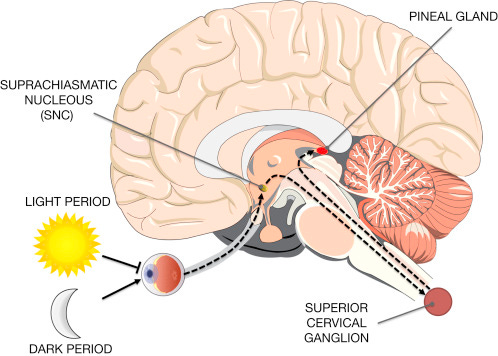
Morning sunlight activates a specific set of cells in the retina — intrinsically photosensitive retinal ganglion cells — that signal the suprachiasmatic nucleus, the brain’s master circadian clock. This signal sets the timing of every hormonal cycle across the day, including when melatonin begins rising in the evening. Bright morning light causes melatonin to peak earlier, higher, and for longer during the night. The absence of morning light — or the substitution of phone screen light for sunlight — leaves the circadian clock without its anchor. Melatonin production begins later, peaks lower, and cuts off earlier. The night feels lighter. The 3am wake-up happens. And no amount of evening sleep hygiene compensates for a morning that gave the circadian clock nothing to work with.
Morning sunlight within 30 minutes of waking
→ retinal ganglion cells activated
→ suprachiasmatic nucleus receives circadian anchor signal
→ cortisol peaks early and drops predictably
→ melatonin production begins rising earlier in the evening
→ deeper sleep achieved at a reasonable hour
→ 3am wake-up becomes less likely.
The school run is already 10–15 minutes of morning outdoor light you’re doing every day. Eyes up. No sunglasses if you can help it. The circadian anchor is already in your routine — you’ve just never been using it deliberately for sleep.
You’ve just read the three habits that are most likely suppressing your melatonin before it has a chance to peak.
Here’s what I’ve noticed working through sleep individually with people:
One of these is always doing more damage than the others.
For some parents it’s the evening — the timing and size of dinner, the late carbohydrates, the cortisol that never drops before midnight.
For others it’s the morning — no outdoor light in the first hour, phone screen as the first input, circadian clock left without an anchor.
For others it’s the breathing — falling asleep in sympathetic mode every night without knowing it.
Which one is closest to your pattern right now?
Reply with your honest answer.
One sentence is enough.
I read every reply personally and I’ll respond with the specific thing that applies to your situation — not generic advice, something that fits where your sleep is actually breaking down.
Reply now. I’m reading.
The exact bedroom temperature that triggers melatonin production — and why most parents’ bedrooms are set 10 degrees too warm without knowing it.
The blue light specifics — why your phone is categorically different from the TV, and the one change that removes its worst effect in under 60 seconds.
And the six foods — with exact timing, exact dosage, and the specific combination that compounds their effect — that restore melatonin production from the inside starting tonight.
