A Stanford psychiatrist spent 20 years studying why people can’t stop.
Not addiction in the clinical sense.
The everyday version.
The scroll that turns into 45 minutes.
The snack that happens when you’re not hungry.
The Netflix episode that becomes four.
Her conclusion:
We are more depressed and anxious than we were 30 years ago
not because our lives are objectively harder —
but because we live permanently hooked on easy pleasure.
And easy pleasure doesn’t fill the tank.
It drains it.
Every fast hit — every scroll, every sugar spike, every notification — produces a dopamine peak followed by a crash that lands you slightly below where you started.
Do that enough times per day, across enough years,
and your baseline drops.
The flat feeling that’s become normal.
The inability to feel motivated by things that used to matter.
The low-grade restlessness that no amount of rest resolves.
That’s not burnout.
That’s a depleted dopamine baseline.
And it resets. But not the way most people think.

Here’s what’s actually happening in your brain.
Your dopamine system doesn’t just produce pleasure.
It sets your baseline — the resting level of motivation, satisfaction, and emotional resilience you wake up with every morning.
When you get a fast hit — a scroll, a sugar spike, a notification — dopamine spikes sharply above baseline. That’s the reward. But what follows is a crash that lands you slightly below where you started. Your brain compensates by reducing its sensitivity to dopamine — producing fewer receptors, firing less readily — to account for the excess.
This is why the second scroll session feels less satisfying than the first.
Why the snack that worked last Tuesday feels less rewarding today.
Why you need more of everything to feel the same effect.
Anna Lembke — Stanford psychiatrist and author of Dopamine Nation — calls this the pain-pleasure balance. The brain maintains equilibrium. Every pleasure creates an equal and opposite dip. Do this enough times, with hits strong enough and frequent enough, and the baseline shifts permanently downward.
The flatness isn’t you.
It’s a biological adaptation to chronic overstimulation.
And the reset is physical, not psychological.
What You’ll Learn:
→ 8 daily habits that reset the dopamine baseline — reordered by the mechanism that makes the reset possible
→ Why stacking pleasures is more damaging than any single one
→ The morning habit that determines your dopamine baseline for the entire day (paid section)
→ The specific exposure that raises dopamine by up to 250% without a crash (paid section)
→ Read time: 5 min
The two that surprise you most are usually the ones that move the needle fastest.
Your brain hasn’t encountered those inputs in a long time.
New signals produce the clearest shifts.
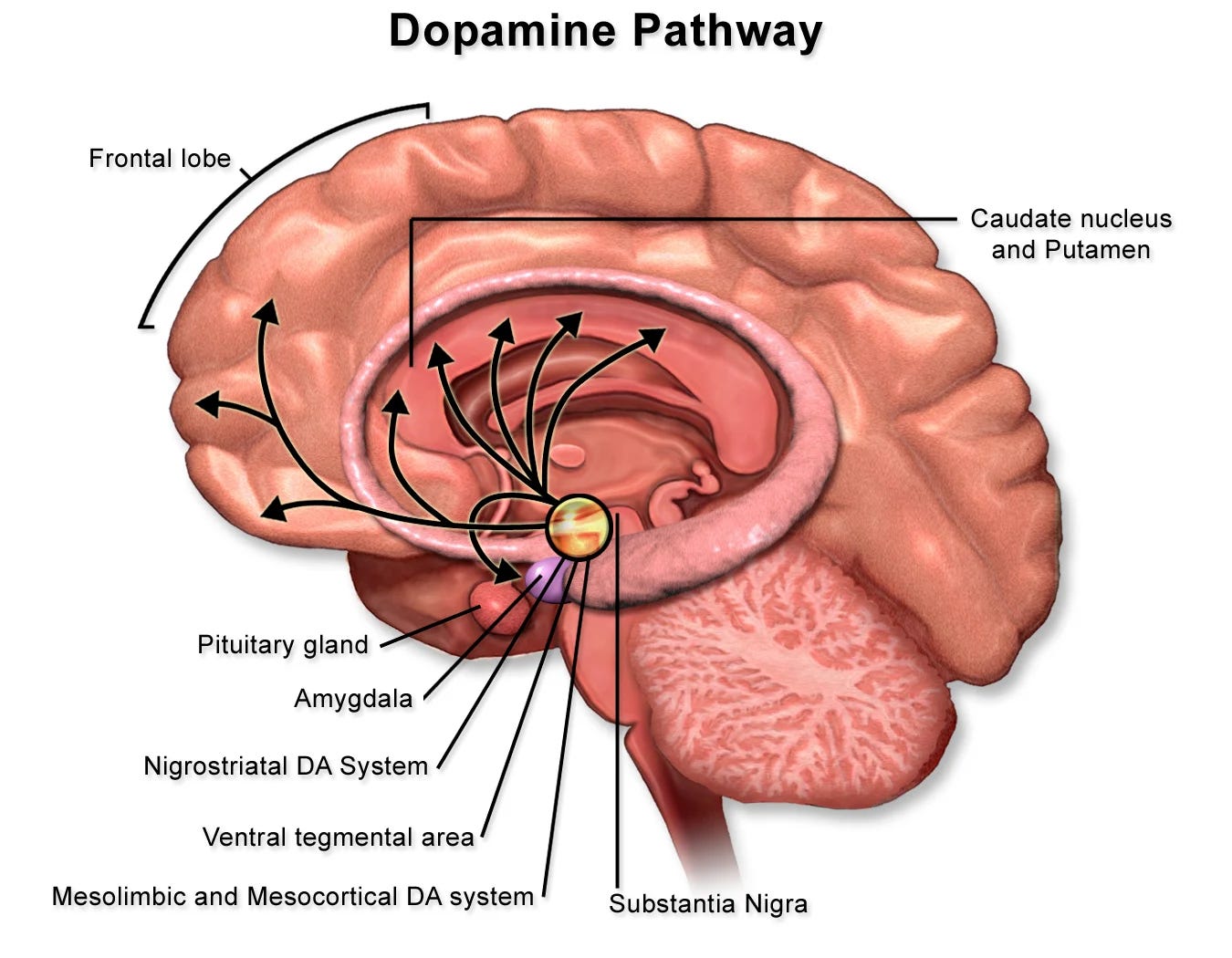
8 Daily Habits That Reset Your Dopamine Baseline
Reordered by surprise — starting with the ones nobody does.
→ 1. Get bored on purpose — the most powerful dopamine reset available and the one everyone avoids
Boredom barely exists anymore. Every gap — the queue, the lift, the red light, the 90 seconds waiting for the kettle — gets filled with a screen. And that elimination of boredom is doing more damage to the dopamine baseline than almost anything else on this list.
Boredom is not an absence of stimulation. It’s a neurological state the brain requires for specific functions — processing recent experience, consolidating memory, generating internally-directed thought, and crucially, allowing the dopamine system to return to baseline after stimulation. When every gap is filled with a fast hit, the system never reaches the recovery phase. The dopamine baseline has no floor to rest on. The brain stays in a state of chronic low-level stimulation that progressively desensitises its own reward circuitry.
Boredom eliminated
→ no recovery phase between dopamine hits
→ baseline progressively depresses
→ dopamine receptors reduce sensitivity
→ ordinary pleasures stop registering
→ flatness becomes the default state.
Every parent knows this gap — the 60 seconds in the school pickup queue before the phone appears. The moment at the dinner table after the kids leave when the hand moves toward the device without a conscious decision. These aren’t failures of discipline. They’re the automated response of a system that has been trained to fill every gap. The boredom that appears in those moments is exactly what the dopamine system needs. Sitting with it — even for 60 seconds — is the reset.
Let the queue be a queue. Let the lift be a lift. Let the kettle boil without picking up the phone. The discomfort that appears in those gaps is the system recalibrating. That discomfort is the protocol working.

→ 2. Stop stacking pleasures — one thing at a time is not a productivity rule, it’s a dopamine rule
Phone while eating. Series while scrolling. Music and snacks and a screen at the same time. Each combination multiplies the dopamine hit. And a multiplied hit means a proportionally deeper crash — and a faster decline in baseline sensitivity.
The brain’s reward system responds to salience — the degree to which a stimulus stands out from its background. When you combine multiple pleasure sources simultaneously, the combined stimulus is far more salient than any single one. The dopamine response is proportionally larger. But the compensatory drop that follows is also proportionally larger. And the desensitisation of the dopamine receptors — the adaptation that lowers the baseline — happens faster and goes further with stacked stimuli than with any single source. Lembke identifies this as one of the primary drivers of the modern dopamine crisis: not that any single pleasure source is too intense, but that we layer them continuously, multiplying the hit every hour of every day.
Stacked pleasures
→ combined dopamine spike far exceeds single-source hit
→ compensatory crash proportionally deeper
→ receptor desensitisation accelerates
→ baseline drops faster than single-source exposure
→ requires increasingly intense stacking to feel the same effect.
The dinner that’s eaten while watching something. The walk that’s done with a podcast and a phone in hand. The Sunday morning that involves coffee and a screen and background music simultaneously. None of these are catastrophic in isolation. Stacked across every waking hour, they’re the primary mechanism depleting the baseline. Eat and taste the food. Walk and feel the movement. One thing at a time is not an ascetic practice — it’s the minimum condition for the dopamine system to register what it’s receiving.
→ 3. Swap fast dopamine for slow dopamine — the pleasure that doesn’t come with a bill
Scrolling, sugar, and ultra-processed food give a sharp peak and an equally sharp crash. Reading, walking, a real conversation, time in nature — these give a lower peak but leave the baseline in positive territory. The difference isn’t the size of the pleasure. It’s what happens after.
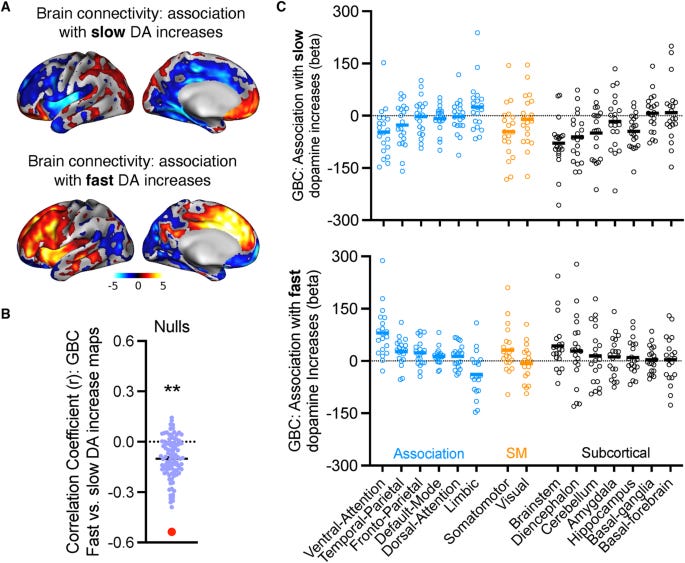
Lembke distinguishes between dopamine sources by their peak-to-trough ratio. Fast pleasures — digital content, refined sugar, alcohol — produce steep peaks followed by crashes that land below baseline. The brain experiences the crash as a state of active discomfort, not merely the absence of pleasure. This drives craving for the next hit — not because the pleasure was enjoyable, but because the crash created a deficit the next hit temporarily resolves. Slow pleasures — physical movement, nature, skilled activity, meaningful conversation — produce shallower peaks but the return to baseline is gradual and often lands slightly above where it started. The brain doesn’t experience a crash. It doesn’t generate craving for the next hit. The system stays in equilibrium.
Fast dopamine source
→ sharp peak well above baseline
→ compensatory crash below baseline
→ active discomfort drives craving
→ next hit required to restore equilibrium
→ baseline progressively lower.
Slow dopamine source
→ moderate peak above baseline
→ gradual return to baseline
→ no compensatory crash
→ no craving generated
→ baseline maintained or slightly elevated.
This is why the walk that felt like a chore leaves you feeling better than the Netflix hour that felt like a reward. The walk gave your dopamine system what it was designed to receive. The Netflix hour gave it what it was trained to want. These are not the same thing.
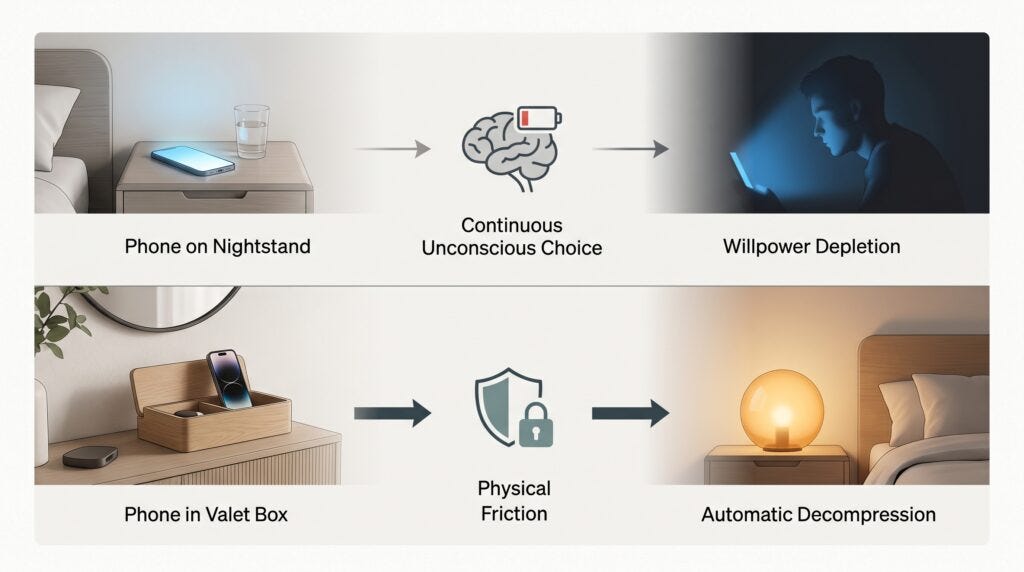
→ 4. Put physical barriers between yourself and the fast hit — it’s not willpower, it’s friction
The brain doesn’t weigh the pros and cons of reaching for the phone. It executes the lowest-friction behaviour available. If the phone is on the table, it gets picked up. If it’s in another room, it mostly doesn’t. The difference isn’t discipline. It’s architecture.
Lembke calls this “self-binding” — the deliberate structural removal of easy access to dopamine sources. The research on friction and behaviour is consistent: even small increases in the effort required to access a stimulus produce large decreases in consumption. An extra 20 seconds of effort to reach a phone reduces impulsive checking by up to 30%. The mechanism isn’t willpower — which is a finite resource that depletes with use. It’s the removal of the automatic behaviour pathway. When the fast hit requires deliberate action rather than automatic execution, the prefrontal cortex has time to engage. The decision becomes conscious rather than reflexive.
Phone on the table
→ automatic reach — no friction — no decision required
→ prefrontal cortex bypassed
→ dopamine hit occurs without conscious choice.
Phone in another room
→ deliberate action required
→ prefrontal cortex engages
→ conscious decision made
→ hit occurs less frequently
→ baseline defended without willpower.
Delete the apps from the home screen. Put the phone in another room during meals. Set a timer that locks the browser after 20 minutes. Use the most inconvenient charger location in the house. None of these require discipline in the moment — they require a single act of architecture when the motivation exists. The friction does the work from there.
Before habits 5–8 — one question I want to ask you directly.
You’ve just read the four habits that address how the dopamine baseline gets depleted.
But here’s what I’ve learned working through this with people individually:
The depletion always has a primary driver.
For some parents it’s the morning — the phone before the kids are awake, setting the chemical tone for a day that never recovers.
For others it’s the evening — the stacking and scrolling that depletes the baseline overnight.
For others it’s the body — the low motivation that makes starting anything feel impossible because the dopamine system has nothing left to draw on.
Which one is closest to where you are right now?
Reply with your honest answer.
One sentence is enough.
I read every reply personally and I’ll respond with the specific thing that applies to your situation — not a generic answer, something that fits where your pattern actually lives.
Reply now. I’m reading.
Habits 5–8 are where the reset actually happens.
Especially habit 7 — the voluntary discomfort protocol that raises dopamine by up to 250% without a crash — and exactly how to build it into a parent’s actual morning without an ice bath or a 5am alarm.
And the full daily sequence — the specific order from waking to sleep that allows the baseline to rise rather than deplete across the day.
The order is the protocol.
The same habits done in the wrong order produce a fraction of the result.